


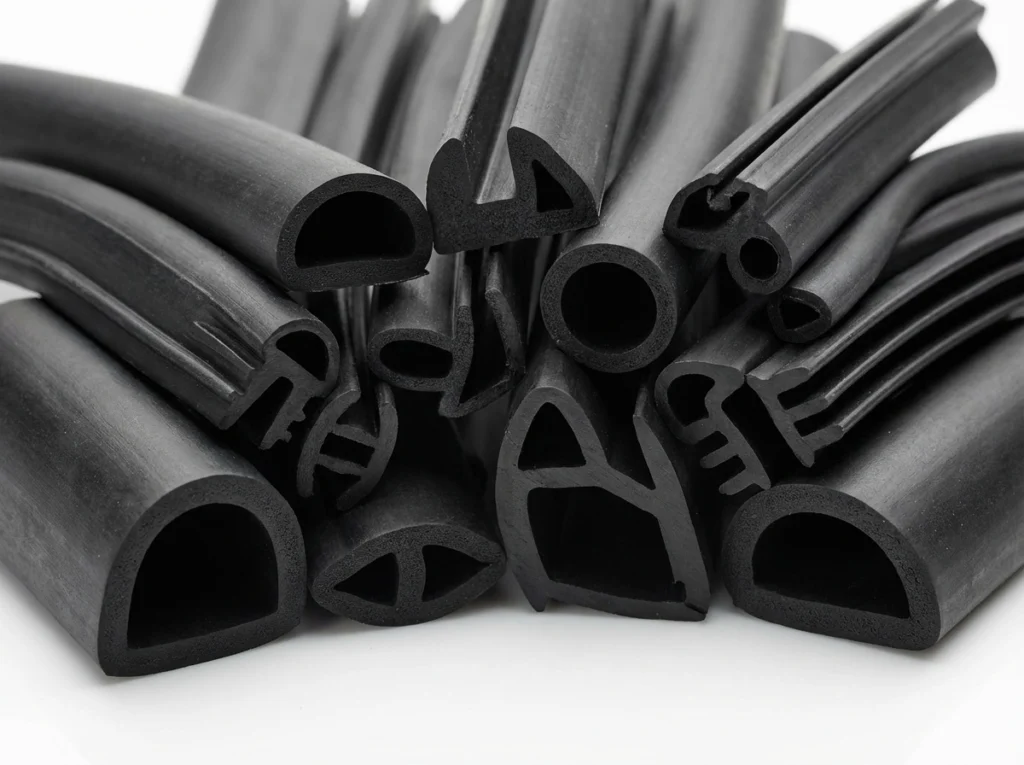
EPDM (Ethylene Propylene Diene Monomer) is a synthetic rubber from the elastomer group. Thanks to its unique chemical structure — consisting of ethylene, propylene, and a diene monomer — EPDM offers an exceptional combination of weather, ozone, and UV resistance.
As a thermoset, EPDM is brought into its final form through vulcanization (sulfur or peroxide curing). This cross-linking gives the material excellent mechanical properties, particularly a low compression set — the seal reliably returns to its original shape after loading.
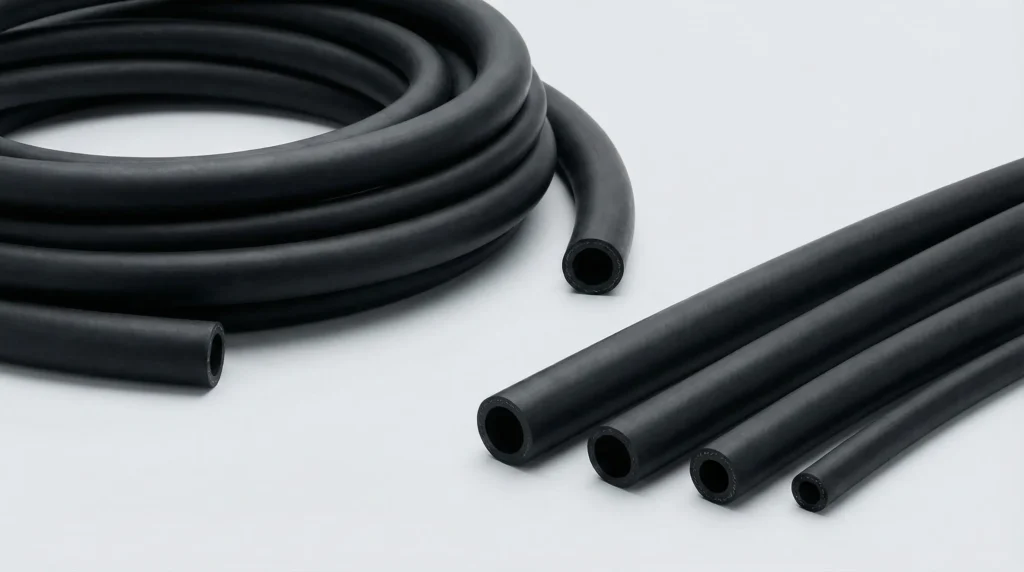
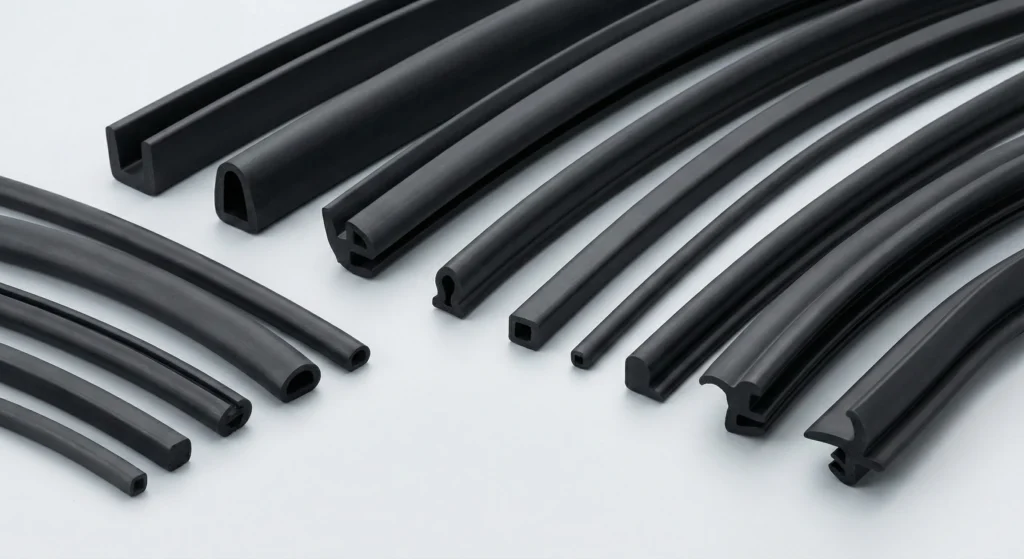
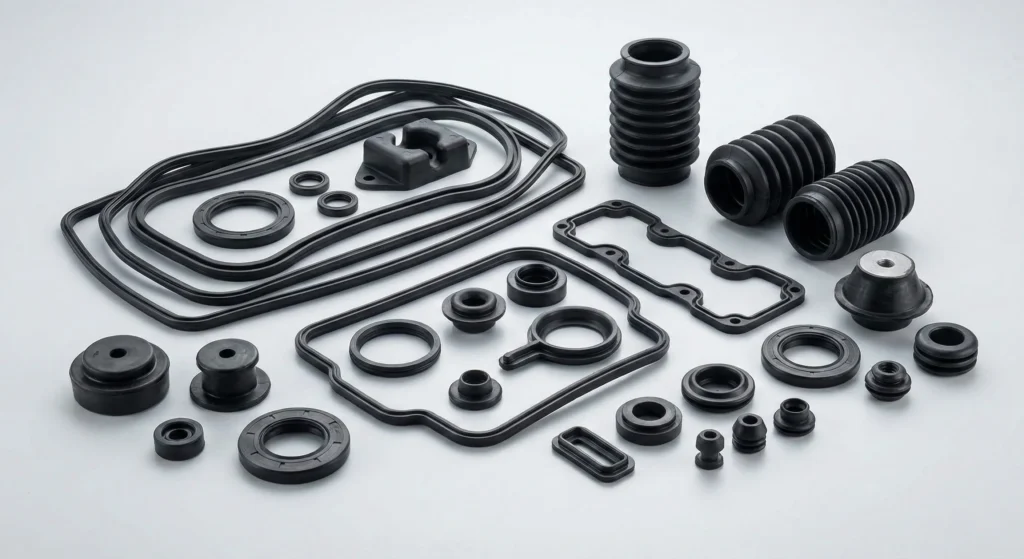
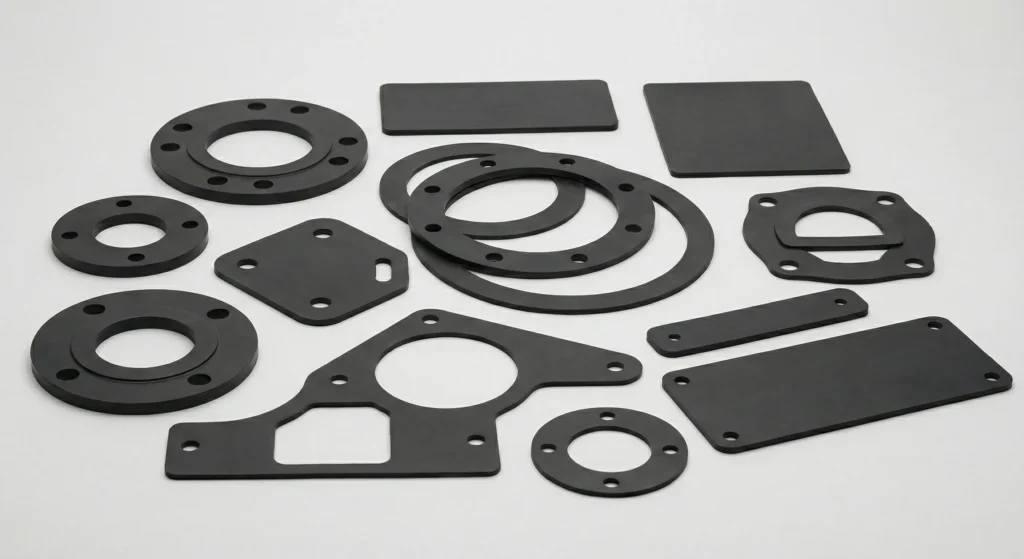
EPDM is used worldwide as the standard material for outdoor applications: roofing membranes, window seals, automotive profiles, solar system seals, and drinking water hoses all rely on this proven material.
Typical service life: 25–50+ years depending on application and compound — one of the most durable elastomers available.
| Industry | Typical Applications |
|---|---|
| Construction | Window seals, facade seals, roofing membranes (service life up to 50+ years) |
| Renewable Energy | Module sealing for PV systems, solar thermal insulation, roof separation layers |
| Automotive & Maritime | Engine compartment seals, glass run profiles, anti-squeak profiles, fender profiles |
| Drinking Water & Sanitary | KTW-BWGL compliant seals, hot water O-rings, steam hoses |
| Civil Engineering & Tunneling | Segment gaskets (durability >100 years), segment linings |
| Industry & Logistics | Vibration dampers, seals for machine housings, vibration decoupling |
| Medium | Resistance | Notes |
|---|---|---|
| Water (cold/hot) | ✅ Excellent | Up to +150°C, drinking water approved |
| Steam | ✅ Very good | Peroxide-cured recommended |
| Diluted acids | ✅ Very good | HCl, H₂SO₄, HNO₃ (diluted) |
| Diluted alkalis | ✅ Very good | NaOH, KOH |
| Alcohols | ✅ Good | Methanol, Ethanol, Isopropanol |
| Ketones (Acetone) | ✅ Good | Short-term exposure |
| Glycol | ✅ Excellent | Ideal for heat pumps |
| Mineral oils / greases | ❌ Not resistant | Severe swelling, loss of strength |
| Fuels (gasoline, diesel) | ❌ Not resistant | Rapid degradation |
| Ozone / UV radiation | ✅ Excellent | Outstanding long-term stability |
| Concentrated acids | ⚠️ Limited | Depends on concentration and temperature |
| Property | Value / Range | Standard |
|---|---|---|
| Hardness (Shore A) | 30 – 90 ±5 | DIN ISO 7619-1 |
| Tensile strength | ≥ 7 MPa | DIN 53504 |
| Elongation at break | ≥ 250% | DIN 53504 |
| Compression set (DVR) | ≤ 25% (72h/100°C) | DIN ISO 815 |
| Density | 1,05 – 1,25 g/cm³ | DIN EN ISO 1183 |
| Temperature range | -40°C to +150°C | — |
| Profile tolerance (extrusion) | ±0,3 mm (Small profiles), ±0,5 mm (Large profiles) | DIN ISO 3302-1 E2 |
| Molded part tolerance | ±0,2 mm (Class M2) | DIN ISO 3302-1 M2 |
| Hose tolerance (ID/OD) | ±0,5 mm (Standard) | DIN ISO 1307 |
We analyze your requirements and jointly select the optimal material (TPE, EPDM, or PVC) for your specific application.
Our experts create precise profiles or molded parts based on your drawings or samples to guarantee a perfect fit.
After precision production, we ensure fast delivery of your finished components – directly to your desired date and location
What does EPDM stand for and what is it made of?
EPDM stands for Ethylene Propylene Diene Monomer. It is a synthetic rubber made from the monomers ethylene, propylene, and a diene (e.g., ENB). The diene component enables sulfur or peroxide cross-linking (vulcanization).
What temperature range can EPDM withstand?
Standard EPDM compounds are suitable for continuous use from −40°C to +120°C. Peroxide-cured special compounds can be used briefly up to +150°C and in certain cases even up to +180°C.
Is EPDM suitable for drinking water?
Yes. Special EPDM compounds are available that are approved for contact with drinking water according to KTW-BWGL (Germany), WRAS (UK), NSF 61 (USA), and other national standards. The compound composition is decisive.
Why is EPDM not oil resistant?
The non-polar chemical structure of EPDM (carbon-carbon chain without polar groups) causes non-polar media such as mineral oils, fuels, and greases to penetrate the material and cause swelling. For oil-resistant applications, we recommend NBR or FKM.
What is the difference between sulfur-cured and peroxide-cured EPDM?
Sulfur-cured EPDM offers better mechanical properties and is more cost-effective. Peroxide-cured EPDM has higher temperature resistance, lower compression set, and is better suited for hot water/steam applications. It also does not cause discoloration on light surfaces.
How long does EPDM last in outdoor use?
EPDM is one of the most durable elastomers for outdoor applications. Facade and roof seals made of EPDM achieve service lives of 25 to 50+ years. The excellent ozone and UV resistance prevents the cracking that occurs in many other elastomers when exposed outdoors.
Can EPDM be made food-safe?
Yes. FDA-compliant (21 CFR 177.2600) and EU Regulation 1935/2004-compliant EPDM compounds are available. These are suitable for seals in food and beverage systems, but require a special compound formulation.
What colors are possible with EPDM?
EPDM is black by default (due to carbon black fillers for optimal properties). Colored variants are possible, but in a limited color spectrum — light and bright colors are more difficult to achieve than with TPE or silicone.
Cookie Settings
We use cookies to provide you with an optimal website experience. This includes technically necessary cookies and cookies for analysis purposes (Google Analytics). You can decide which categories to allow. More information in our Privacy Policy.
We support companies across industries with custom solutions in EPDM, PVC and TPE. Send us your inquiry — we’ll get back to you quickly.
✓ Response within 24h · No spam · +49 1705587294
✓ Response within 24h · +49 1705587294