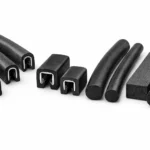
An EPDM bulb seal is designed to stay in contact with preload at the largest gap without being compressed solid at the smallest gap. Chamber height, wall thickness and Shore hardness are the decisive factors, because together they determine the usable compression travel and the closing force. A solid profile can only be compressed a limited amount before the forces rise sharply. A hollow chamber buckles under load, so with a suitable design the force stays at a flatter level over a longer travel. For this reason bulb seals are used on doors, flaps, housing covers and joints where manufacturing tolerances, distortion or settlement make the gap vary by several millimetres.
From gap size to profile height: start with the tolerance chain
One possible cause of leaking bulb seals is a profile designed for the nominal gap dimension. The design should start from the tolerance chain instead. This means the smallest and largest gap in the installed condition, including sheet metal tolerances, hinge play, frame distortion and thermal expansion. These two limit values define the working range the profile has to cover.
As a guide value, a compression of about 20 to 50% of the profile height is often assumed for hollow profiles. The range varies by manufacturer, chamber shape and compound. For a specific cross-section, this range has to be confirmed against its force-deflection curve. At the largest gap, the profile should still be compressed within the lower part of this range so that it can compensate for unevenness in the mating surface. At the smallest gap, the chamber must not be fully compressed. Once the walls lie on top of each other, the profile behaves like a solid cross-section, the closing force rises abruptly and the permanent deformation increases. If a single cross-section cannot cover the range, the answer is a larger chamber or a double chamber, not a softer compound.
Chamber shape: round, D, P or multi-chamber
The chamber shape determines how the profile buckles. A round tubular cross-section yields evenly but tends to roll sideways when pressed at an angle. The D-profile has a flat base, sits stably and is suitable for adhesive and groove mounting. In the P-profile the chamber sits on a tail that is clamped, riveted or bonded. This leaves the chamber free to move, so it also follows lateral offset of the door.
For very large tolerances or stepped forces, double and multi-chamber profiles are an option. With a suitable geometry, a softer chamber makes contact first at low force, and a stiffer chamber then takes up the remaining gap and the preload. Whether the chambers work one after the other or together depends on wall thicknesses and arrangement, and this should be checked on the force-deflection curve. The drawing should show the direction of compression. A profile loaded across its intended direction can buckle asymmetrically. Depending on geometry and installation, the sealing line then shifts or the contact pressure becomes uneven. An overview of common cross-sections is available under EPDM sealing profiles.
Wall thickness and Shore hardness determine the closing force
For profiles, closing force is stated as force per length, typically in N/100 mm, and is determined from a force-deflection curve. Wall thickness is a sensitive parameter. In a simplified bending model, the bending stiffness of a wall increases with the cube of its thickness. How strongly this affects the overall curve compared with hardness depends on chamber shape and deformation range. Even 0.5 mm of additional wall thickness can change the curve significantly. For hollow chambers in dense EPDM, hardnesses of about 60 to 70 Shore A are common. As a guide value, wall thicknesses are typically between 1.5 and 3 mm. The actual value depends on chamber size, how well the compound can be extruded and the specifications of the manufacturer concerned.
A typical mistake is trying to reduce excessive closing force with a softer compound. Depending on formulation and processing, a softer compound can have a higher compression set. It can also make thin walls harder to extrude, because they can collapse during vulcanisation. A thinner wall, a larger chamber or a chamber made of EPDM sponge rubber is usually more effective, combined with a dense mounting base in co-extrusion. A hardness tolerance of ±5 Shore A is standard in the industry. With thin walls, this can mean noticeable force differences between batches.
Recovery behaviour and material selection
If a bulb seal stays flat after a few months, it has often been used outside its working range or is made from a compound with too high a compression set. Thermal ageing or chemical attack by media can also reduce recovery permanently. Compression set is tested to DIN ISO 815-1. The enquiry should state it together with test temperature and test duration, because values without these conditions cannot be compared. Peroxide-cured EPDM typically has a lower compression set and higher temperature resistance than sulphur-cured EPDM.
EPDM is resistant to weathering, ozone, water and many polar media. Depending on the compound, it is typically used from about -40 °C to +120 °C. EPDM is not resistant to mineral oils, mineral-oil-based greases or fuels. If oil mist is present in a machine housing, a different material should therefore be considered. For contact with drinking water, KTW-BWGL and DVGW W270 apply. Under US regulations, FDA 21 CFR 177.2600 covers rubber articles intended for repeated use in contact with food. For other markets, food compliance has to be clarified separately. These requirements belong in the first enquiry, because they determine the compound.
Fixing method and typical installation errors
The fixing method affects sealing behaviour more than many drawings allow for. Clip-on profiles with a metal insert sit on sheet metal edges, so the flange thickness range has to be specified. Mounting bases with arrow or fir-tree geometry need a toleranced groove width. Otherwise the profile slips out or cannot be fitted. Self-adhesive versions need a smooth, grease-free surface and a high enough application temperature. On powder-coated or textured surfaces, adhesion should be tested beforehand.
Profiles are often stretched while being fitted. They then contract again, leaving gaps at joints and corners. In closed frames with vulcanised corners, the chamber may be sealed off at the corners, depending on how the corner joint is made. If this makes the cavity airtight and there are no vent holes, the trapped air acts as a spring. The closing force rises and the door springs back.
What an enquiry for a bulb seal should include
For a reliable design, the manufacturer needs the minimum and maximum gap, the direction of compression, the permissible closing force per length, the fixing method with mating dimensions, media and temperature range, and the required standards. If only a sample or an existing profile is available, a sectional drawing of the installation situation is more useful than a photo of the cross-section. Dimensional tolerances of the cross-section are usually agreed to DIN ISO 3302-1 in classes E1 to E3. Tighter classes increase the effort and are only worthwhile for functionally relevant dimensions.
For new cross-sections, only the extruded sample shows whether the walls come out evenly and whether the force-deflection curve suits the application. A sample run at the extrusion technical centre before series release avoids later tool modifications, because wall thickness and chamber height can then be checked on the real part in its installed position.
Häufige Fragen
How much can an EPDM bulb seal be compressed?
As a guide value, about 20 to 50% of the profile height, depending on manufacturer, chamber shape and compound. What matters is that the chamber is not fully compressed at the smallest gap. If the inner walls touch, the force rises sharply and the profile loses its recovery more quickly.
When is sponge rubber better than a dense hollow chamber?
Sponge rubber is suitable when low closing forces are required, for example on light flaps or on housing covers with few fasteners. Dense hollow chambers are more dimensionally stable and more wear-resistant when the profile is operated frequently or subjected to mechanical load. The two can be combined by co-extrusion.
Why is the door harder to close than expected after the seal has been fitted?
Common causes are a gap that is smaller than the drawing assumes, a wall that is too thick, or air trapped in an airtight frame seal without venting. The corners are also stiffer than the straight profile. Comparative measurements on the sample show which factor dominates. Useful comparisons are a straight section against a corner, different gap sizes, and the seal with and without venting.
What information does the manufacturer need to quote to drawing?
The manufacturer needs a cross-section drawing or sample, the minimum and maximum gap, the direction of compression, the fixing method with flange thickness or groove dimensions, the temperature range, media contact, the required standards, and the form of supply: continuous lengths, cut lengths or vulcanised frames.