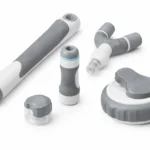
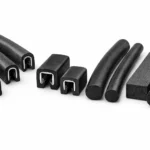
In TPE injection moulding, demoulding and sealing performance depend on three things. The wall thickness should be uniform, typically 1 to 3 mm, the hardness should match the function, and the gate should sit in the thickest cross-section. Whether a part demoulds cleanly and seals reliably also depends on the tool concept, processing and installation conditions. In 2K parts, the material pairing determines adhesion: many SEBS-based TPS compounds bond to PP without additional measures, while PA and ABS require adhesion-modified grades. The following sections show what design engineers and buyers should check before sending an enquiry and where moulded parts fail in practice.
Selecting the material and Shore hardness by function
TPE covers several material classes. Seals, grip zones and dampers mainly use TPS (styrenic block copolymers, usually SEBS-based) and TPV (a crosslinked EPDM phase in a PP matrix). For higher mechanical loads or oil contact, TPU or TPC are more likely choices. TPS can be formulated from very soft up to about 90 Shore A. At elevated temperatures, TPV typically retains a lower compression set. For statically loaded seals with continuous temperatures above about 70 °C, it is therefore worth comparing TPV or crosslinked EPDM, because TPS can lose considerable recovery force at these temperatures, depending on the compound.
Shore A hardness is measured to ISO 48-4 on test specimens at least 6 mm thick. On a finished part with a 1.5 mm wall, or on the rigid substrate of a 2K part, the durometer gives different readings, usually higher on a hard substrate. The drawing should therefore specify the material hardness with tolerance, typically ±5 Shore A as is customary in the industry, rather than a hardness test on the part. Static seals with low closing force are typically 40 to 70 Shore A, and soft-touch grip zones are often 30 to 60 Shore A. Softer compounds seal with less force but, depending on the compound, show a higher compression set.
Wall thickness and demoulding
TPE is a poor conductor of heat. Material accumulations cool slowly, extend the cycle and lead to sink marks or voids. Uniform wall thicknesses of typically 1 to 3 mm with rounded transitions between thick and thin areas have proven effective. Thick sealing beads are better designed hollow or with a recess than solid. Sealing lips that taper to a sharp edge may fill incompletely, depending on the flow path, or tear during demoulding. A defined thickness at the lip tip and a radius at the lip root prevent both.
Soft compounds allow undercuts for which a thermoplastic would need slides. Whether an undercut can be force-demoulded depends on hardness, undercut depth and demoulding temperature, and is checked as part of the tool concept. Draft angles of typically 1° to 2° are sufficient for smooth surfaces. For textured surfaces, the plastics engineering rule of thumb is about 1° extra per 0.025 mm of texture depth. Very soft grades stick to polished mould surfaces. Lightly textured surfaces, large-area ejectors, stripper plates or air ejectors prevent thin ejector pins from pressing into the part.
Gate location, weld lines and shrinkage
The gate is placed in the thickest cross-section so that the melt flows from thick to thin and the holding pressure reaches the thick areas. Weld lines form where flow fronts meet, for example behind openings. They must not lie on a sealing surface or in the bonding zone of a 2K part, because strength and adhesion are reduced there. The gate mark does not belong on the sealing contour either. The drawing should mark the permissible areas for the gate and parting line rather than leave this decision open.
TPE melts are highly shear-thinning. At high shear rates they flow very easily and penetrate fine gaps, so parting lines and vents must be kept tight, otherwise flash forms on the sealing edges. Shrinkage is typically between 0.5 and 2.5%, depending on the compound, and differs along and across the flow direction. Where functional dimensions are tight, a filling simulation and sampling in the injection moulding technical centre should come before series release, because the final dimensions can only be confirmed on the real part.
Bonding in 2K parts to PP, PA and ABS
In a hard-soft combination, adhesion results from the compatibility of the polymers at the interface, not from an adhesive. Melt temperature, surface temperature of the pre-moulded part and contact time determine the achievable bond strength. TPS and TPV typically bond to PP without additional measures. For ABS, PC and PC/ABS there are adhesion-modified TPS grades, and for PA 6 and PA 66 there are dedicated PA-bonding grades.
In a multi-component mould with a rotary table, index plate or transfer gripper, the pre-moulded part is overmoulded while still warm, which promotes adhesion. Inserts must be clean and free of release agent. PA inserts must also be dry, because absorbed moisture significantly reduces adhesion. Preheating the inserts improves the bond. Glass-fibre-reinforced or flame-retardant grades of the rigid component change adhesion and are tested with the specific grade.
In design terms, the TPE layer should not end as a free edge on a smooth surface. It should end in a groove or behind a step, so that it cannot be peeled off in use. The soft component is typically at least about 1 mm thick, and thicker with long flow paths. Openings or undercuts in the rigid component provide an additional mechanical anchor. Bond strength is tested to VDI 2019 in a 90° peel test with a test sled. Processes and material pairings are described on the page on TPE multi-component parts.
Sealing function: compression, groove volume and media
A TPE seal works through compression and recovery force. For static seals with a compact cross-section in a groove, such as round cord or O-ring-like profiles, 15 to 30% compression is often used as a starting value. Elastomers are virtually incompressible, so the groove must accommodate the displaced volume and thermal expansion. For such groove seals, a groove fill of no more than about 85% is the usual starting value. These values cannot be applied to sealing lips and hollow-chamber profiles, where geometry and the force-deflection curve determine the design. A common mistake in material selection is comparing compression set values from data sheets measured under different test conditions. Values to DIN ISO 815-1 are only comparable at the same temperature and test duration, and figures to other test standards cannot simply be compared with them.
Depending on the compound, TPS swells considerably in mineral oils and greases, so other materials should be considered for oil contact. For drinking water contact, for example in household appliances with a water connection, compliance with the KTW-BWGL and DVGW worksheet W270 must be clarified. In the USA, FDA 21 CFR 177.2600 applies to rubber articles intended for repeated use in contact with food. In the EU, Regulation (EU) No 10/2011 applies to plastics in contact with food. In medical technology, the raw material manufacturer provides evidence of biocompatibility, for example to ISO 10993. The suitability of the finished product is assessed by the party placing it on the market.
What to include in an enquiry based on a drawing
An enquiry can be assessed without follow-up questions if the drawing clearly specifies sealing and functional surfaces, permissible areas for the gate and parting line, and dimensional tolerances. For elastomer parts these are typically to DIN ISO 3302-1, and for thermoplastic moulded parts alternatively to DIN ISO 20457. The enquiry should also state the material or requirement profile with Shore hardness and tolerance, service temperature, media and required standards. A STEP file in addition to the drawing makes it easier to check demoulding and the flow path.
For 2K parts, the exact designation of the rigid component is needed, i.e. the manufacturer and trade name of the grade rather than just PA 6 GF30, because additives affect adhesion. Colour, surface requirements and expected annual volume are equally important, because they determine the tool concept: an insert process with a simple mould or a multi-component mould with a rotary table. Documents can be submitted directly via the page for custom TPE moulded parts made to drawing.
Häufige Fragen
Does TPE bond to POM?
Common TPE compounds achieve virtually no adhesive bond to POM. With this pairing, the soft component is anchored mechanically, for example via openings, undercuts or circumferential grooves in the rigid component. Alternatively, it is worth checking whether the rigid component can be switched to PP, ABS or PA.
Can a 2K TPE moulded part have undercuts?
Yes, provided the part can stretch over the core during demoulding. In 2K parts, the rigid component limits this stretching, so undercuts are better placed on the free TPE side. Rounded undercut flanks with a shallow run-out demould more easily than sharp-edged ones and are less likely to tear.
When is EPDM a better choice than TPE?
At elevated continuous temperatures and under long-term static compression, crosslinked EPDM typically retains a lower compression set than TPS. It is usually also the better option for hot water and steam. TPE plays to its strengths when the part is produced as a 2K component with a thermoplastic, when short cycle times are required or when sprues are to be recycled.
Does TPE need to be dried before injection moulding?
That depends on the material class. Many standard TPS grades absorb hardly any moisture. Adhesion-modified grades for PA, as well as TPU and TPC, are sensitive to moisture and are dried according to the data sheet. Moist pellets cause splay marks, bubbles and weaker adhesion in 2K parts.
Can TPE moulded parts be coloured?
TPE is usually coloured with masterbatch. The masterbatch carrier must be compatible with the TPE base, otherwise surface quality and adhesion in 2K parts suffer. With very soft compounds, the addition can shift the hardness slightly, so hardness is verified on the coloured material.